Posted in Squire

The Worshipful Company of Cutlers

The Cutlers’ Company, by the death of Mr. Augustus Squire, has lost a member of upwards of 66 years’ standing, … whose family has been associated with the Cutlers’ Company for upwards of two centuries.” – published 9 Jan 1907

The Squire family in London had important ties to the Cutlers’ Guild, which has proved invaluable in researching the family and being able to verify I was tracing the right William Squire and his sons in the historical records. 

For a long time, I had reached a dead end researching the origins of Frederick Squire (1812-1885) (KGVJ-W7B), my 4th great-grandfather, who was born in England, emigrated to the United States (probably in the 1830s), and lived in New York and Pennsylvania.  The only thing I had been able to find was a census record that said he had been born in London.  

I finally had a breakthrough when I discovered the transcription of a letter to Frederick from his father, W. Squire, dated 1850, which mentioned Frederick’s siblings.  Using those names, I was able to find the parish christening records for a family with all the same children as in the letter, whose parents were William and Mary Squire. The first five, including Frederick, were born in London, and the last four were born on a farm near a small town in Bedfordshire.  This seemed very odd that the family would move from London to the country—the opposite direction of most migration of the time period.  But I was able to find records that each of the younger sons moved back to London and applied for the membership in the Cutlers’ guild and citizenship in the City of London.  To do so, they had to prove they were legitimate children born to a father who had been a member of the guild before they were born.  These applications were the critical link that verified for me that I had found Frederick’s family.
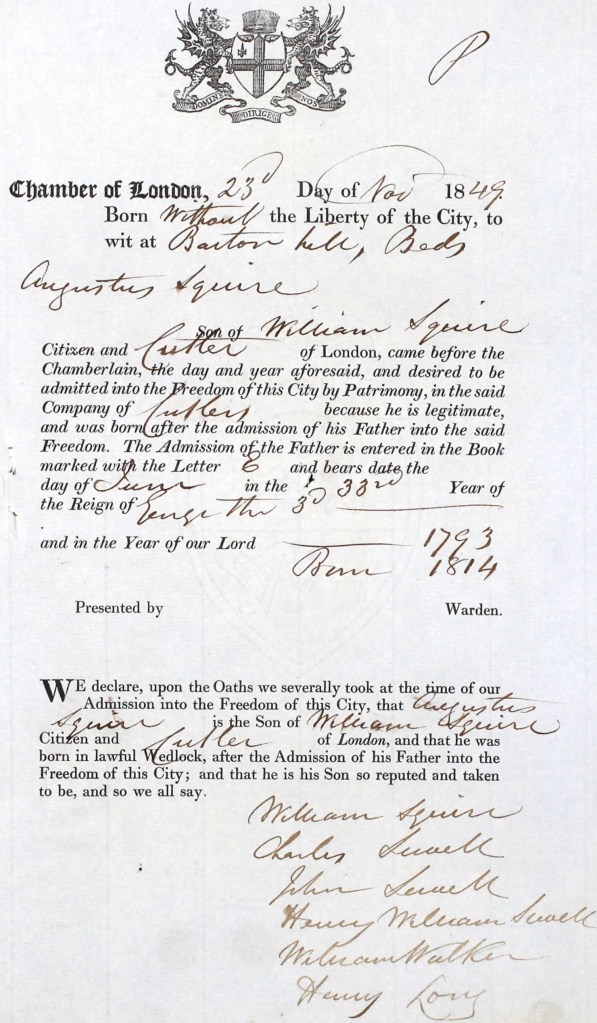
Note that you can see William Squire’s signature on this document

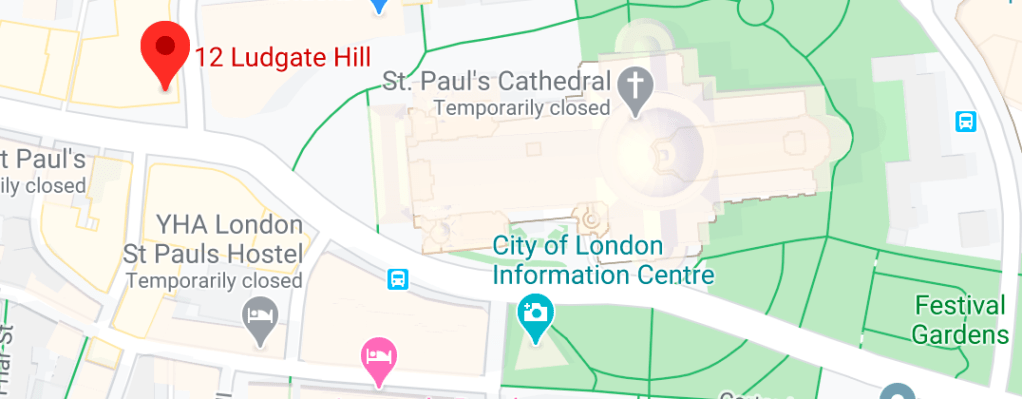
William Squire (KGVR-8NH) apprenticed to become a cutler when he was 14 years old on 11 March 1786, a 7-year contract during which time he had to train and work for a master cutler, in this case his father, Thomas Squire (2Z3X-5DW). He completed his apprenticeship and was admitted to the Cutlers’ Company in June 1793.  He worked at 12 Ludgate Hill—just steps from St Paul’s Cathedral in London—as a cutler, silversmith, and jeweler until 1812, when he moved his family to Bedfordshire. 
The Worshipful Company of Cutlers—as it is formally called—is one of the most ancient of the City of London livery companies and received its first Royal Charter from Henry V in 1416. Their business was producing and trading in knives, swords, and other implements with a cutting edge. Its origins are found among the cutlers working in the medieval City of London in the vicinity of Cheapside.  Thomas Squire lived in Cheapside (just on the other side of St. Paul’s Cathedral) and William probably grew up there, continuing this cutler connection.
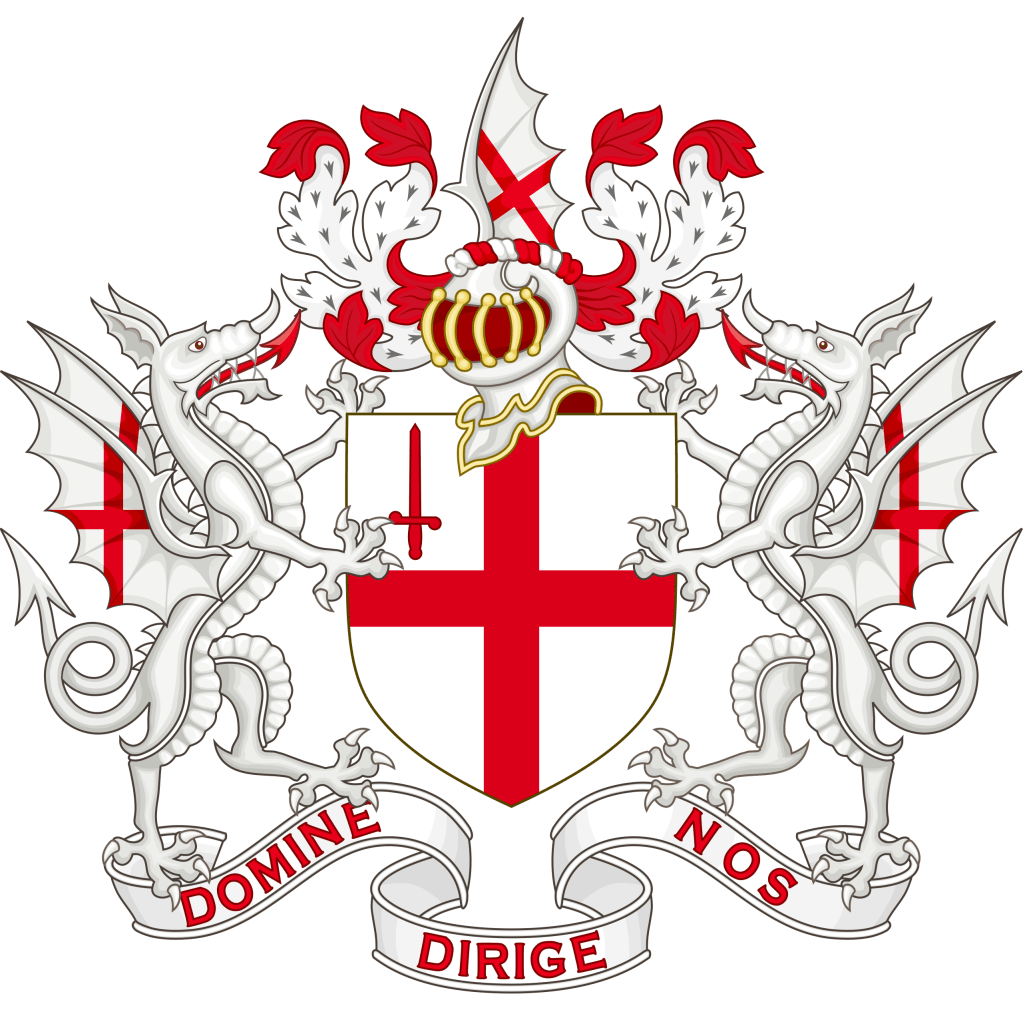
The City of London Coat of Arms

None of William Squire’s children became cutlers; in fact, as far as I can tell, William never worked as a cutler, silversmith or jeweler again after 1812. So, why did all of William’s sons join the guild? Because it gained them citizenship and voting rights in the City of London, which is different than the London metropolitan area. (To learn more about the City of London and the significance of having citizenship there, check out two excellent videos by CGP Grey: here and here.) From the Middle Ages to the Victorian era, the Freedom of the City was the right to trade, enabling members of a Guild or Livery to carry out their trade or craft in the City of London.

With the demise of the sword making and cutlery trade in the City during the 19th century, the Company directed its attention towards expanding its charitable activities with particular emphasis on supporting education. The Worshipful Company of Cutlers basically became a club like the Lions or Rotary clubs in the United States.  Today the Company combines these charitable endeavors with maintaining the traditions of the City of London; supporting the Mayoralty; providing fellowship and hospitality; and preserving the Company’s Hall and other assets for the benefit of future generations.  
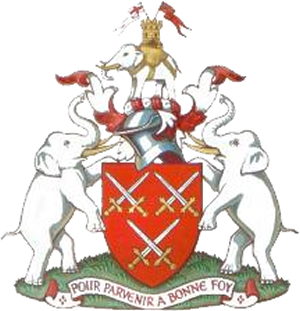
Cutlers’ Company Coat of Arms

Many of William Squire’s decedents remained active in the organization, including serving as senior leaders of the guild, and membership was passed down by patrimony to several of William’s grandsons, at least. For example, Augustus Squire (2Z3X-BRM), 6th child of William, was an active member of the Company for 66 years, and until nearly the end of his life, he never missed a single one of its meetings or dinners, according to the newspaper account at his death. Henry Graves (2Z3X-B63) (see previous post), son-in-law of William, was a guild member and Master of the Cutlers’ Company, as was his son, Algernon Graves (LJR7-PD9). (A 1903 fashion article described Algernon’s wife as “the Mistress Cutler of London” when describing her dress for an event she and Algernon attended.) Augustus’s sons, Christopher and Edward Squire, also were active guild members.

This has been valuable, genealogically, because they are in the City of London voter registration lists (available on Ancestry.com), which lists eligible voters by guild.  This allowed me to keep track of the correct Squire men over time and separate them from the hundreds of other Squires (often with the exact same name) living in the London area at the time. Having their exact address had proved crucial because often that is the only clue to confirm I am looking at the right person in christening, marriage, and burial records, which usually contain scant information about the person in the record but frequently include their address.
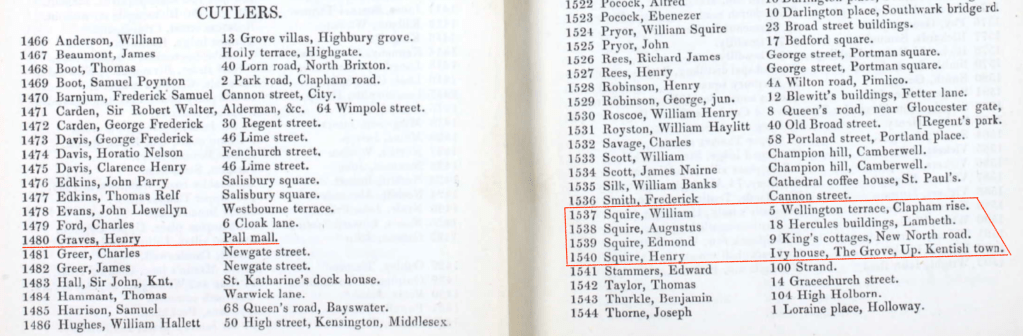
Register of persons entitled to vote in the elections for the City of London as Freemen of the city – 1855

Posted in Photo, Squire

Diphtheria Outbreak Breaks Family’s Heart

From Mary Josephine Squire’s (KWZV-7RH) autobiography:

“While we were living in Fredonia, N.Y., my brother Page contracted diphtheria in school. If I remember correctly (I was 7 1/2 at the time), he came home from church sick. It was his 9th birthday, 4 May 1909, and he had just joined the Methodist Church that day. He was desperately sick, and one week later he died. There was no funeral because he had died of a contagious disease.”

“My father was the only person beside the hearse driver who went to the cemetery. The picture is still vivid in my mind of the hearse driving away on that cold, windy muddy May day with all that was left of our darling brother. The only glimpse Raymond or I had had of Page since that fateful Sunday was through a window.”

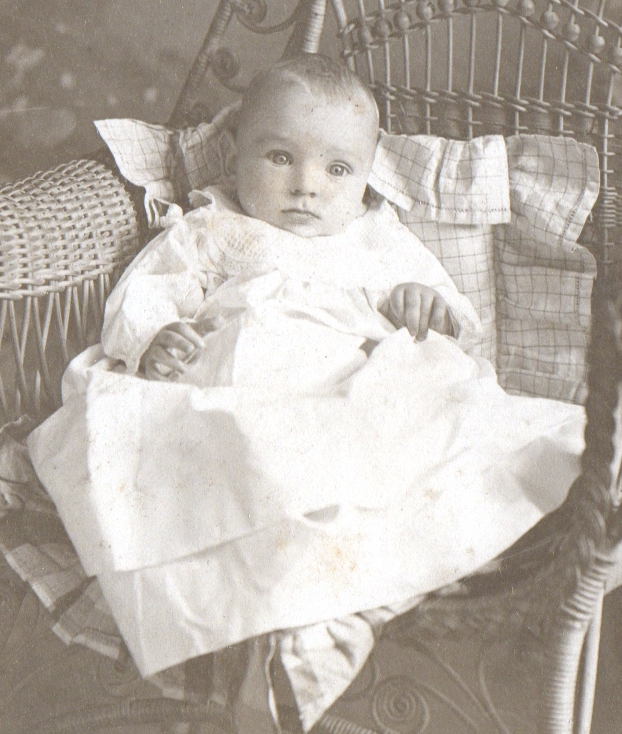
Edmond Page Squire as a baby

“Page was very like his father, sweet, kind, and unselfish. Our loss was surely Heaven’s gain! Many years later my mother told me that just before Page died, all of a sudden he sat straight up in bed and seemed to look off in the distance and smiled and seemed to look radiant. Then he lay back down and died. Perhaps he saw a chariot and angels coming to get him.”

“My mother took every precaution and Raymond and I did not contract the disease. But since Page had contracted the disease at school, mother would not send me back to school until the truant officer came and enforced attendance.”

The outbreak of diphtheria in Fredonia was not like the pandemic of coronavirus we are having in 2020. It was a smaller outbreak, but diphtheria outbreaks happened regularly in the United States and around the world when Mary was growing up. Like coronavirus, it is a respiratory disease (though caused by a bacteria) with some similar symptoms, including sore throat, loss of appetite, and fever. It is also spread similarly, from person to person, usually through respiratory droplets, like from coughing or sneezing. Before a vaccine was invented in the 1920s, diphtheria was one of the most feared infectious diseases, with mortality rates as high as 40 percent, and was a major cause of childhood mortality.

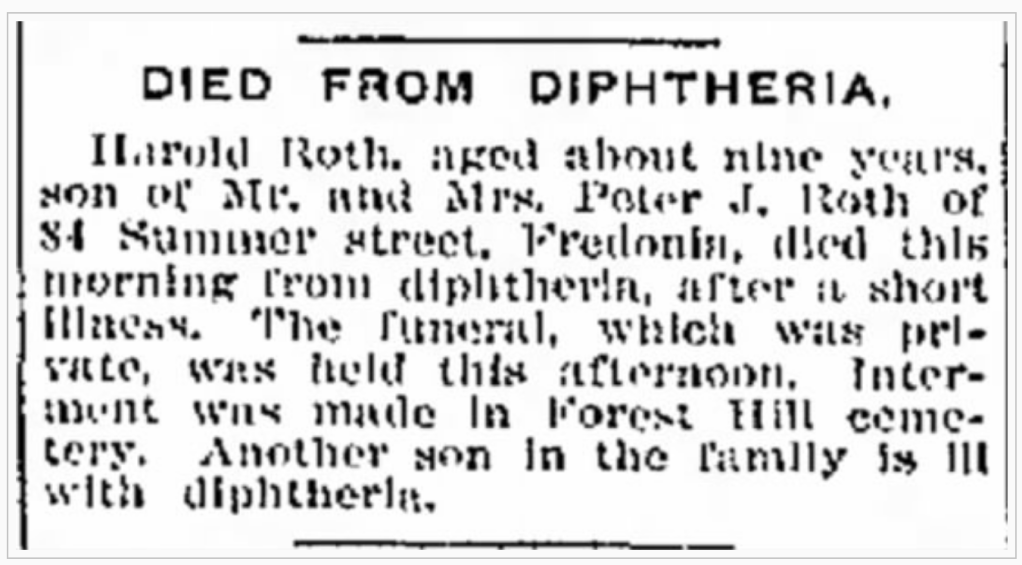
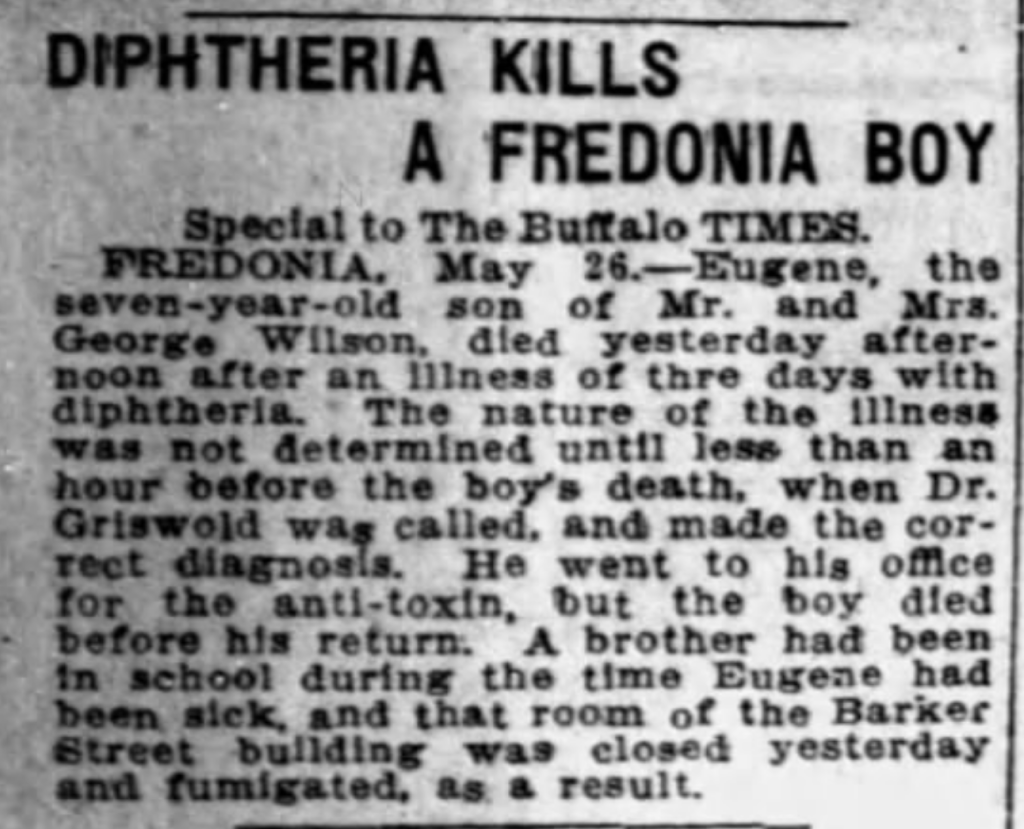
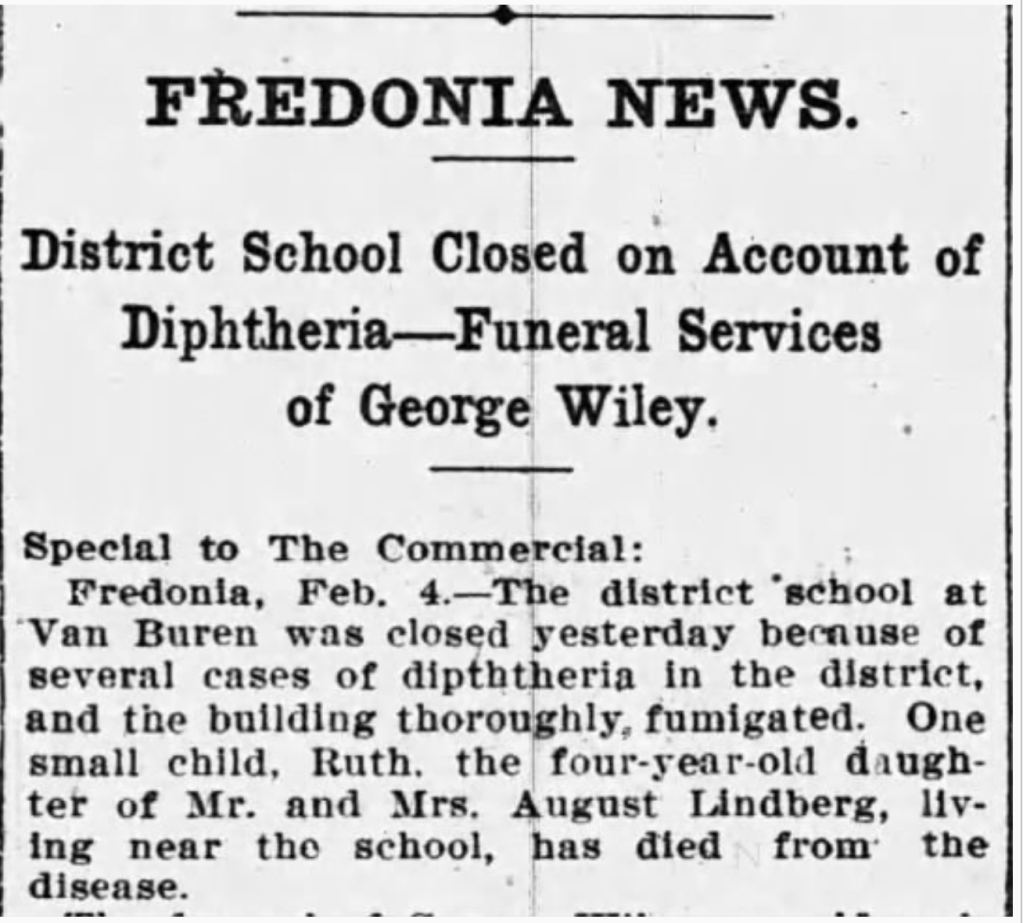
At least a few other children died from the outbreak that killed Page Squire. I couldn’t find any news articles about his death, but I found a few about other children who died around the same time.

Three months earlier, the school district was closed because of several cases of diphtheria. You can understand why Laura Squire did not want to send Mary back to school until she was forced to. It was a scary time to live and have kids with so many early childhood diseases that we can now avoid thanks to vaccines.

Posted in Photo, Squire

The Early Years – Mary J Squire

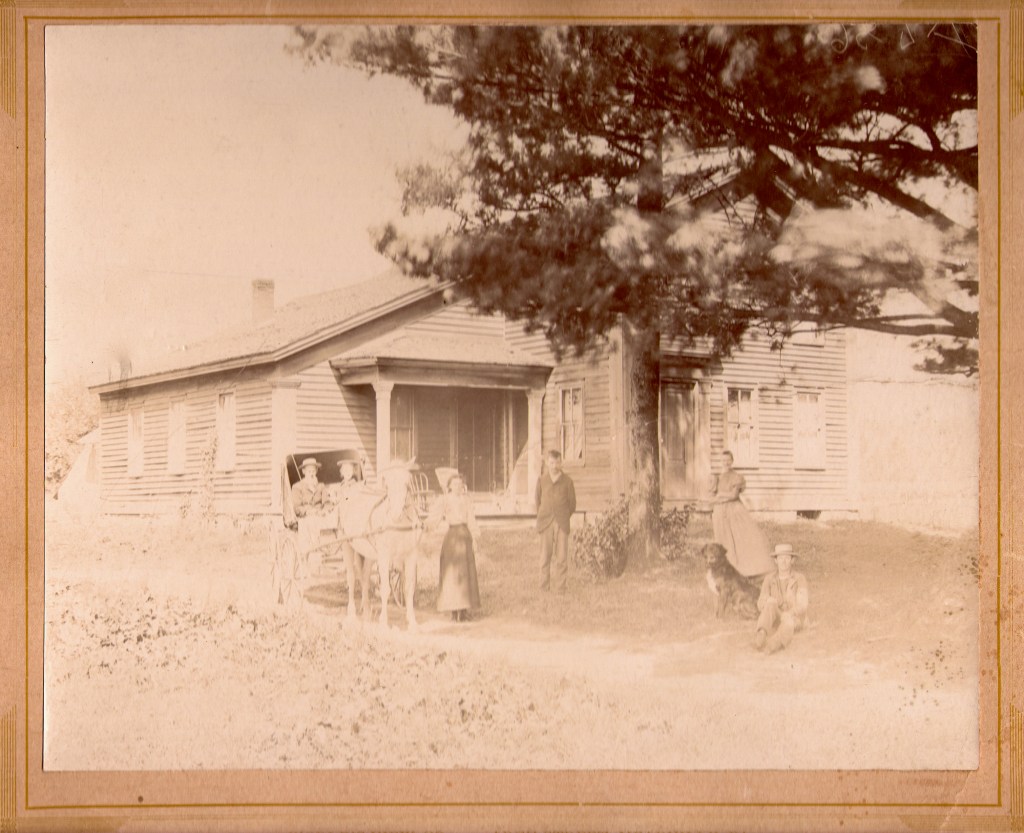
In her autobiography, Mary Josephine Squire (KWZV-7RH) wrote about often spending time at her grandparents’ house as a child. She was born in their house and often visited their dairy farm, 1 mile east of Spartensburg, Pennsylvania. “To arrive at this farm from Spartensburg, one had to go up over a hill and cross a high iron bridge over a creek. The farm was just on the other side. To me the bridge looked as if it rose about a mile into the sky.”

“The house was 30 or 40 feet from the road, and this front yard had several huge pine trees between two of which was hung a hammock in summer. On hot summer evenings or Sunday afternoons after Church, dinner and chores, one of the men often took a snooze in this hammock. But the rest of the time my brothers and I could enjoy it.”

Edmond Squire’s Farm at Spartensburg, Pennsylvania
Unfortunately, I don’t know who the people in the picture are

“Summers were happy times on the farm. We played with the Collie dog, Shep, or with the Gould children who lived a short distance away, picked four leaf clovers from the big field which came clear up to one side of the house, or sometimes went across the field to visit our great grandfather, Joseph Morse Jenkins.”

“It was quite confusing when my playmates spoke of their different grandfathers and grandmothers as I didn’t know anyone had more than one set. My brothers and I only had one set and wondered how come others had more. My father’s father had married my mother’s mother when my parents were in their teens. They grew up together and were brother and sister as well as husband and wife.”

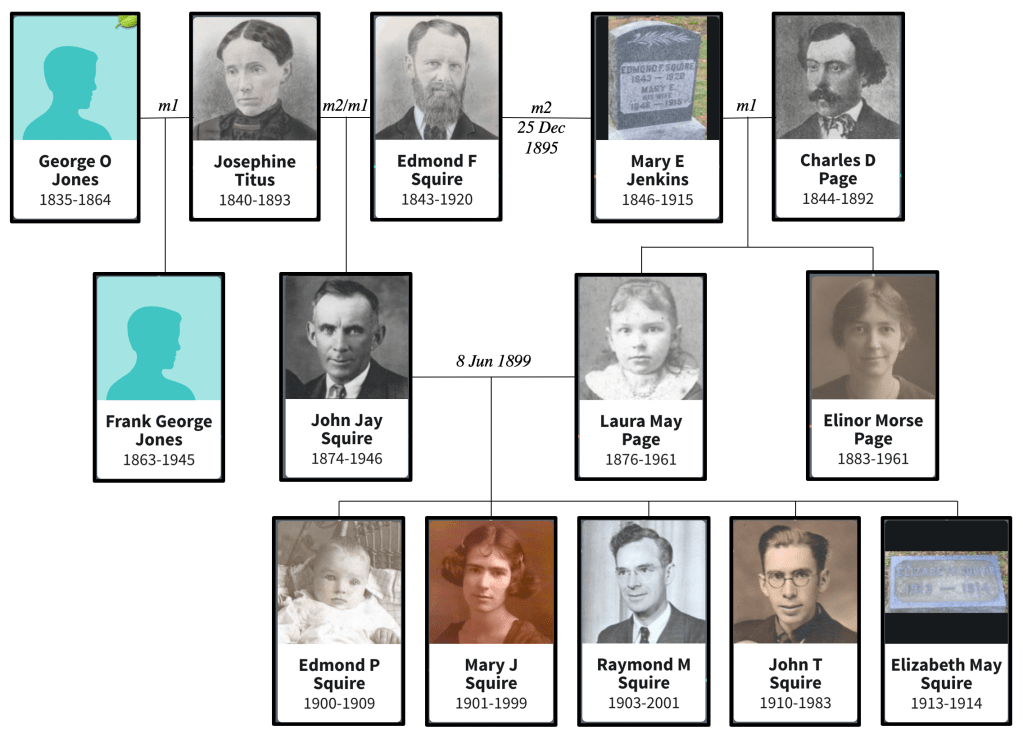
In case you didn’t catch all that, here is the chart.

John Jay Squire married his step-sister Laura May Page three and a half years after their parents married each other. But John was 21 years old and Laura was 19 years old when their parents married, so it is not like they grew up in the same house together.

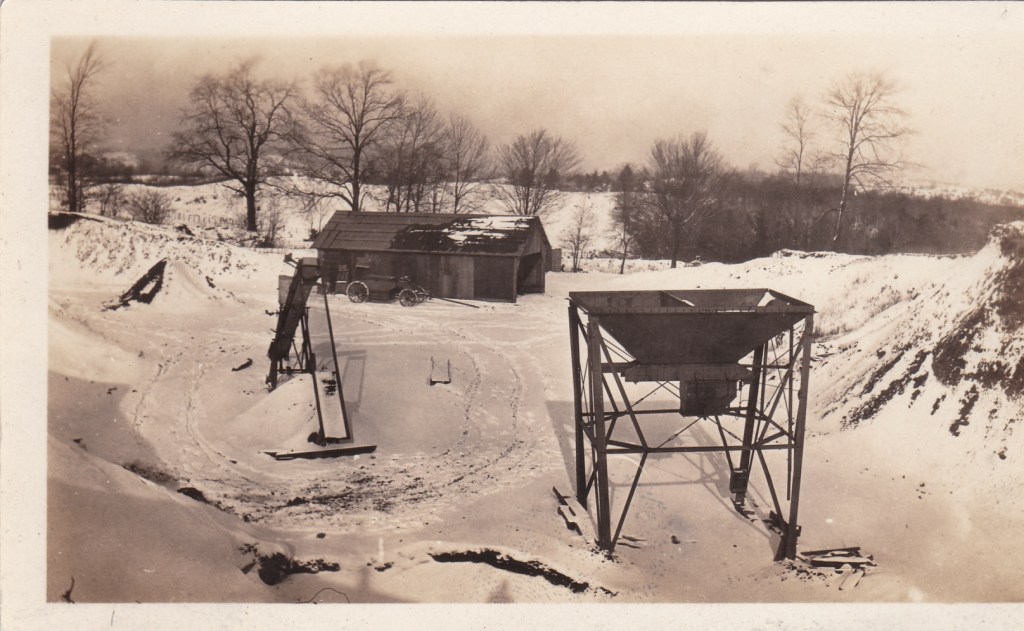
“In December of 1912, at my grandparents wishes, we left the vicinity of Fredonia, New York, and moved to Corry, Pennsylvania, where my grandfather helped my father to get started in the sand, gravel and cement block business. My grandfather purchased a piece of ground with veins of sand and gravel and a half a dosen Irish shanties, the largest of which we tried to make into a home.”

“All of the buildings were in various stages of disrepair. The house was small with four little rooms on the first floor and a room and a half under the eaves. It was so cold that winder that dad banked the house with straw and manure from the barn to keep us from freezing. We often had to wade up to our hips in snow drifts to get to school.”

“Eventually we tore down and replaced or dispensed with all the little outshanties – the little house over the well, the many chicken coops, tool shed, wood shed, and privy. When mother sold the house after dad died in 1947, it was an entirely different looking place with its additions, improvements, shingled exterior, enclosed porches and a nice double garage. In place of the shanties surrounding the house, there were trees, flowers, a rock garden and big lawns.”

John Jay Squire’s sand and gravel pit
Posted in Photo, Squire

A Family of Engravers, Artists, and Art Dealers

Lately I have been researching the family of William Squire (1772-1857, KGVR-8NH), of London, England, who is my 5th great grandfather.  I am currently working through everything I can find out about his children. His second oldest child, Mary Squire (2Z3X-BHD) married Henry Graves (2Z3X-B63) on 6 Jan 1831 in St. James’s Piccadilly Anglican church in London. On each of the census records for the family, Henry’s occupation was listed as publisher of engravings, which I didn’t really understand.  But I could tell the family was well off because they had three to four live-in servants, including a governess, cook, and one or two maids.  Then I found an obituary for Henry that said he was the well-known printseller and the son and grandson of notable London printsellers and the brother of the distinguished line engraver, Robert Graves.

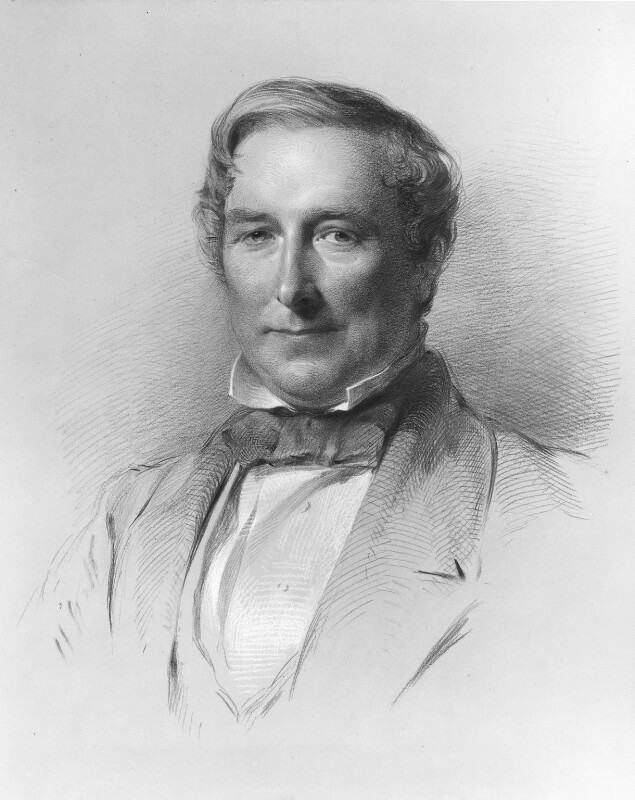
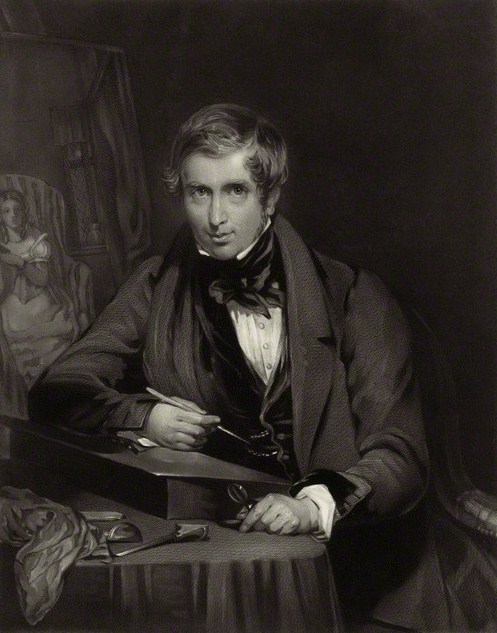
Henry Graves about 1855
©National Portrait Gallery, London, used by permission

A Google search led me to Wikipedia entries for Henry and Robert Graves and then to the National Portrait Gallery, London website, which has a collection of portraits of Henry, Robert, and their father, also Robert.  It also has a collection of portraits they engraved and published.  

Henry Graves started out, at age 16, as an assistant to an art dealer. He later joined another company and was the manager of their print department. When that firm failed in 1825, he and several others acquired the business, with various partnerships until 1844, when Henry became sole proprietor of the firm Henry Graves & Co. The 1871 UK Census notes that Henry had 11 employees.  He also was one of the founders of ‘Art Journal’ and ‘Illustrated London News,’ which began publication in 1842 and was the world’s first illustrated newspaper. Its extensive coverage of the royal family’s tours, lives, and deaths earned the paper popularity.  

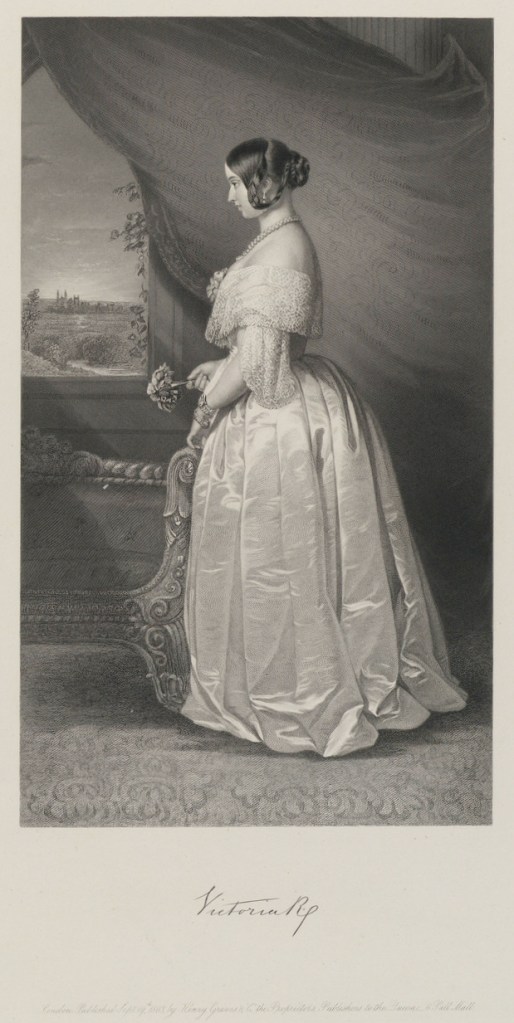
Queen Victory a print by Henry Graves & Co
The caption at the very bottom that you can barely see says, “London. Published Sept 19th 1863 by Henry Graves & Co., the Proprietors, Publishers to the Queen at Pall-Mall

Henry Graves and Co., like many commercial art galleries, began as a print publishing business, and gradually moved into the exhibition and sale of paintings and other fine arts.  There are 230 portraits associated with Henry Graves & Co at the National Portrait Gallery, London.  Graves published an immense number of fine engravings from pictures by Turner, Wilkie, Lawrence, Constable, Landseer, Faed, Frith, Grant, Millais, and other contemporary painters. He specially devoted himself to the reproduction of the works of Sir Edwin Landseer, employing the best engravers of the day, and paying the artist himself more than £50,000 for copyrights. He also issued valuable library editions of the works of Reynolds, Lawrence, Gainsborough, Liverseege, and Landseer. 

At a time without photographs, scanners or copy machines, line engravers and printsellers enabled art and images of events to reach a much wider audience.  Henry died in 1892, at the age of 85. Henry’s younger son, Algernon, of whom I have done very little research so far, carried on the business.  However, by the end of Henry’s life, photography was beginning to replace the need for engraved prints.

Robert Graves, 1835
© National Portrait Gallery, London, used by permission

Robert, Henry’s older brother, pursued the other half of the business, engraving. He became the pupil of John Romney, a line engraver, in 1812, when he was 14 years old. He initially focused on pen and ink facsimiles of rare prints and had much success, according to his biography in the Oxford Dictionary of National Biography. However, he later decided to devote all his attention to engraving, and he masterfully recreated the works of many artists. A contemporary art critic wrote that his plates (that he engraved) are generally characterized by their refinement and delicacy and in these qualities they can scarcely be surpassed. In 1836 Graves was elected an associate engraver of the Royal Academy and he presented as his diploma work a portrait of Lord Byron from the original by Thomas Phillips. He created many plates to print works by famous artists.  His last was a portrait of Charles Dickens, from the original by William Powell Frith, for a book about novelists.  He died in 1873, at the age of 74.

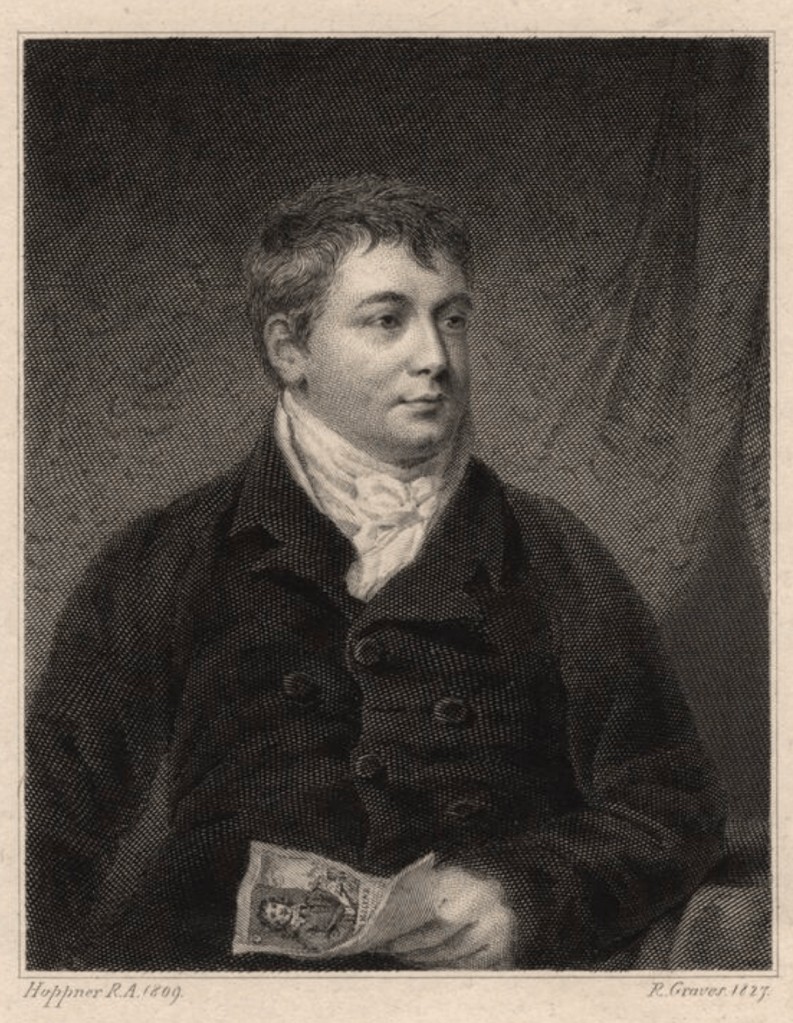
Robert Grave (d. 1825), 1809
Line engraving, 1827, by his son Robert Graves
©National Portrait Gallery, London, used by permission